

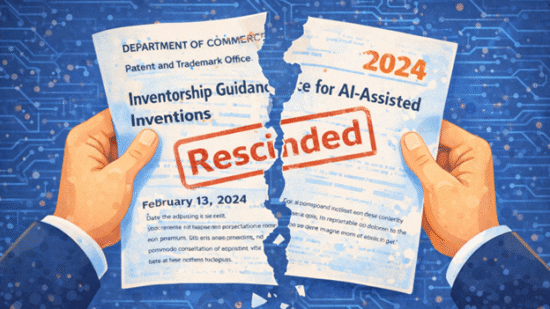
PatentNext Summary: The USPTO has rescinded its February 2024 inventorship guidance for AI-assisted inventions and replaced it with revised guidance issued on November 28, 2025, so prior materials relying on the earlier guidance should be treated as outdated. The revised guidance emphasizes traditional conception-based inventorship, makes clear that AI may assist but cannot be an inventor, and flags a practical priority risk where a foreign filing naming an AI system as the sole inventor can undermine U.S. priority claims. It also underscores that the guidance reflects USPTO examination policy—not binding law—so courts (or Congress) may ultimately provide the controlling rules.
****
Back in March 2024, I summarized the USPTO’s then-new Inventorship Guidance for AI-Assisted Inventions here: The U.S. Patent Office provides Inventorship Guidance for AI-Assisted Inventions.
That post is now outdated.
On November 28, 2025, the USPTO issued “Revised Inventorship Guidance for AI-Assisted Inventions” as examination guidance, and the Office expressly rescinded its February 13, 2024 guidance in its entirety, replacing it with the revised guidance. See Revised Inventorship Guidance for AI-Assisted Inventions.
Why the USPTO says it changed course
The USPTO’s revised notice explains that the February 2024 approach relied on applying the Pannu joint-inventorship factors to AI-assisted inventions, and that approach has now been withdrawn.
The Office’s rationale is straightforward: Pannu is directed to determining whether multiple natural persons qualify as joint inventors.
The revised guidance reframes the analysis around traditional inventorship doctrine without trying to “fit” an AI tool into a human joint-inventor test.
The revised guidance’s core themes
First, the revised guidance reinforces a familiar anchor point: conception. The notice reiterates that conception turns on whether the inventor can describe the invention with particularity, and it emphasizes the evidentiary importance of demonstrating possession of a complete mental picture.
Second, the USPTO doubles down on the “AI as a tool” framing. It states that AI systems (including generative AI) are instruments used by human inventors, analogous to laboratory equipment, software, research databases, and other tools that assist the inventive process.
In the USPTO’s view, AI may provide services and generate ideas, but it remains a tool used by the human inventor who conceived the claimed invention.
Third, the revised guidance signals how examination will proceed when applicants get inventorship wrong. The USPTO states that it will take action (including a rejection under 35 U.S.C. §§ 101 and 115, or other appropriate action) for claims in any application that lists an AI system or other non-natural person as an inventor or joint inventor.
Finally, there is an important international/priority practice point. The revised guidance explains that, for benefit/priority under various statutory provisions, the U.S. application must name the same inventor (or have at least one joint inventor in common), and that for AI-assisted inventions this still requires a natural person inventor.
As a result, the USPTO states that a priority claim to a foreign application that names an AI tool as the sole inventor will not be accepted.
Practical implications for applicants and practitioners
If you have internal guidance, client alerts, invention disclosure forms, or training materials that cite the USPTO’s February 2024 guidance—or that rely on the February 2024 “Pannu factors” framing for AI-assisted inventorship—those materials should be refreshed promptly, because that approach has been rescinded and withdrawn.
On the prosecution side, the revised guidance’s emphasis on traditional conception principles is a reminder to keep good records showing human conception (particularly where AI outputs are involved), and to sanity-check inventorship when preparing ADS materials, declarations, and priority/benefit claims.
Closing thoughts
Two takeaways remain the headline: AI can help you invent, but it can’t be the inventor under current USPTO practice.
And, of course, it’s worth underscoring that this is USPTO examination guidance, not binding law.
We will have to wait to see how U.S. courts (or dare I say Congress) address these issues to provide legally binding clarity.
****
Subscribe to get updates to this post or to receive future posts from PatentNext. Start a discussion or reach out to the author, Ryan Phelan, at rphelan@marshallip.com or 312-474-6607. Connect with or follow Ryan on LinkedIn.