

PatentNext Takeway: Ex parte Desjardins—and especially the USPTO’s decision to make it precedential—appears to be shifting examination away from § 101 and toward § 112 written-description scrutiny, particularly for AI-related inventions. For AI-related inventions, a central takeaway is that practitioners should expect more examiner demands for concrete disclosure of how an AI model is trained, what inputs and outputs are used, how preprocessing and post-processing occur, and how inference or agentic workflows actually operate. Prosecution data and a recent office action example also suggest that written-description rejections are increasing both overall and in AI applications. The practical implication is that patent applicants should not rely on high-level “black box” AI descriptions, but instead should draft specifications with enough technical detail to demonstrate possession of the claimed invention.
****
Background: the Ex parte Desjardins decision
On September 26, 2025, the USPTO’s Appeals Review Panel (“ARP”) in Ex parte Desjardins vacated a sua sponte § 101 rejection directed to claims for training a machine-learning model. The panel concluded that the claims, when viewed as a whole, were not merely directed to an abstract idea, but instead integrated any abstract idea into a practical application because they improved the operation of the model itself. As the decision emphasized, the claimed approach improved sequential learning by preserving performance on prior tasks while learning new ones, with the specification identifying reduced storage use and reduced system complexity as technical benefits.
PatentNext’s October 3, 2025, article, “Artificial Intelligence Patent Claims Get a Boost: USPTO Director Vacates §101 Rejection in Desjardins,” framed the ruling as an early but important signal that AI- and software-based inventions may receive a more disciplined eligibility analysis when the claims are tied to a concrete technological improvement.
That signal became more consequential on November 4, 2025, when Director John Squires designated the decision as precedential. PatentNext’s November 5, 2025, follow-up, “Update: Desjardins Decision Made Precedential,” explained why that mattered: once precedential, the reasoning of Desjardins no longer serves merely as persuasive commentary, but instead binds examiners and the PTAB.
The USPTO’s own announcement likewise described the designation as part of the Office’s promised direction on subject-matter eligibility. In practical terms, Desjardins now stands as a precedential reminder that claims should not be rejected at too high a level of generality where the claim language reflects a real improvement in computer or machine-learning functionality.
At the same time, Desjardins should not be read as a broad deregulatory decision for AI claims. Quite the opposite: it redirects scrutiny. The opinion expressly states:
This case demonstrates that §§102, 103 and 112 are the traditional and appropriate tools to limit patent protection to its proper scope. These statutory provisions should be the focus of examination.
For patent practitioners, that is the key practical takeaway. Desjardins may reduce overreliance on § 101 in appropriate AI and software cases, but it also invites closer attention to written description, enablement, definiteness, novelty, and obviousness.
As discussed below, the early data supplied here suggests that one immediate consequence may be increased examiner reliance on § 112 written description rejections, particularly where claims recite sophisticated AI functionality without corresponding technical detail in the specification.
Rising Section 112 (Written Description) Rejections at the USPTO following Ex parte Desjardins
Since Ex parte Desjardins was made precedential on November 4, 2025, the data reflected in the charts below suggests that written description rejections under § 112 have increased relative to § 101 rejections. The two sets of graphs below cover the period from March 2025 through March 2026 and compare § 101 and § 112 rejection activity both across all applications and across a filtered subset of AI-related applications. Although temporal correlation alone does not prove causation, the timing is notable. Desjardins expressly redirected examination toward §§ 102, 103, and 112, and the post-November 2025 trendlines are consistent with that policy signal.
Section 112 (Written Description) Rejections across All Art Units
The first set of figures (below) compares the numbers of § 101 and § 112 rejections across all applications, spanning all technology centers and art units. Figure 1 provides a side-by-side time-series comparison of total § 101 rejections versus total § 112 rejections over time. The chart shows that § 112 rejections remain above § 101 rejections throughout the period, and that the separation appears to widen somewhat after Desjardins and, more noticeably, after the decision was made precedential on November 4, 2025. In other words, the post-Desjardins environment appears to reflect increased examiner use of § 112 relative to § 101 across the patent corps as a whole.
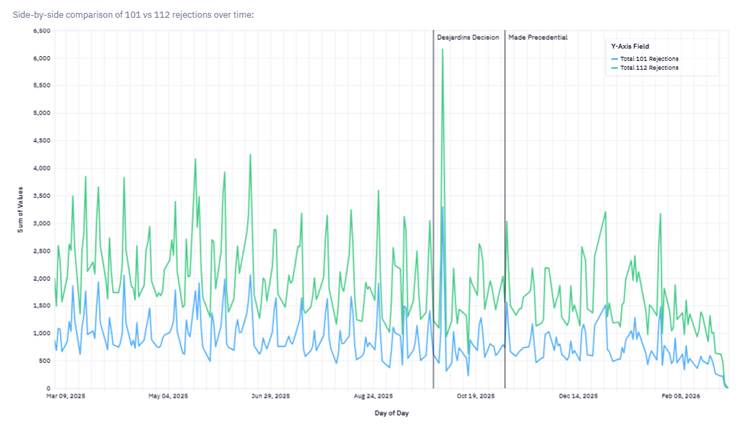
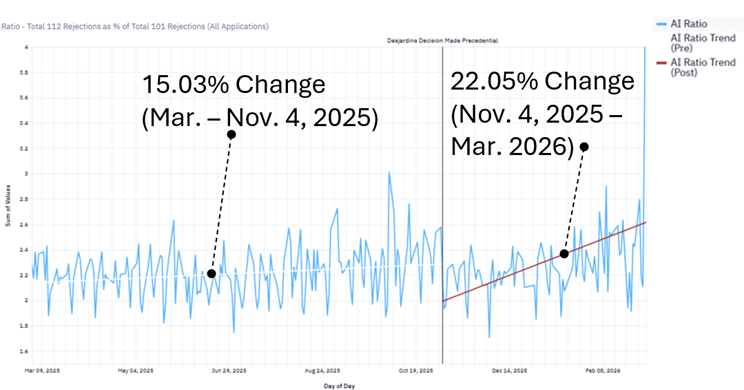
Figure 2 (below) illustrates the ratio of total § 112 rejections as a percentage of total § 101 rejections for all applications. Before the precedential designation, the chart shows a pre-November 4, 2025 trendline at 0.1503, i.e., 15.03%. After the precedential designation, the post-November 4, 2025 trendline rises to 0.2205, i.e., 22.05%.
That shift reflects an increase of approximately 47% in the § 112-to-§ 101 ratio. Put differently, if one uses § 101 as a rough baseline for comparison, § 112 written description rejections are consuming a materially larger share of the rejection mix after Desjardins was elevated to precedential status.
Section 112 (Written Description) Rejections for AI-based Applications
The second set of figures focuses on AI-related applications. Figure 3 (below) compares the numbers of § 101 and § 112 rejections over time for that AI-related subset. The side-by-side series shows a more pronounced convergence than appears in the all-application data (above). While § 101 rejections remain substantial, § 112 rejections appear to move closer to them after Desjardins, especially once the decision became precedential. That converging overlap suggests that written description scrutiny is becoming a more central examination tool, particularly for AI applications.
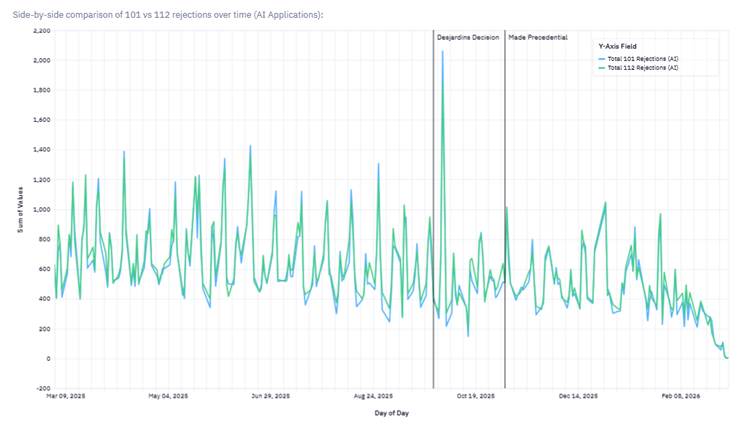
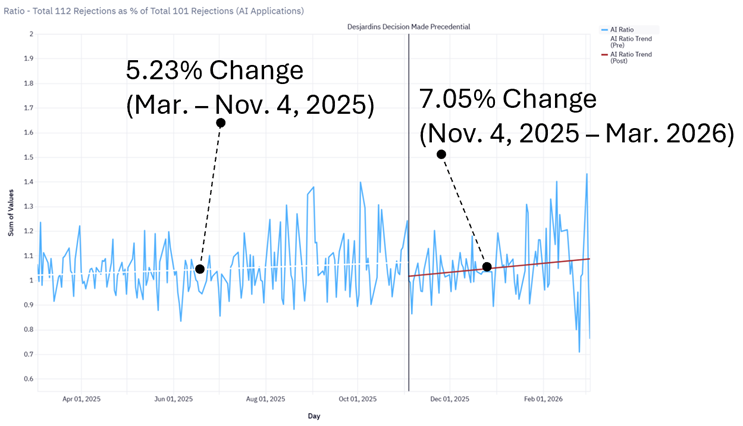
Figure 4 presents the ratio of total § 112 rejections as a percentage of total § 101 rejections for the AI subset. Before the precedential designation, the chart shows a trendline at 0.0523, or 5.23%. After November 4, 2025, the trendline rises to 0.0705, or 7.05%.
That represents an increase of approximately 35%. The numerical change is smaller than in the all-application dataset, but the directional movement is the same: after Desjardins, § 112 appears to be gaining ground relative to § 101 in AI examination.
For practitioners, that matters because AI claims often survive or avoid a § 101 challenge only if they are cast as improvements to model training, inference, or system operation. Once the Office accepts that framing, the next question becomes whether the specification actually describes the claimed technical solution with enough specificity to show possession of it.
The practical implication is straightforward. Desjardins may make it easier to argue that certain AI claims are not “directed to” an abstract idea under current USPTO practice, but it may simultaneously make it harder to prosecute under § 112 if the specification speaks in high-level functional terms only. As the charts suggest, examiners appear increasingly willing to test that boundary. Applicants that describe an AI model merely as a black box, or that recite desired outputs without explaining training inputs, feature engineering, model logic, inference steps, or post-processing, should expect sharper written description scrutiny going forward.
Example Section 112 Rejections
One likely consequence of Desjardins is that AI prosecution disputes will increasingly migrate from § 101 to § 112(a). In practice, that means more examiner demands for specification support showing how a claimed AI model is trained, what pre-processing and post-processing steps are used, how inputs are transformed during inference, how a generative AI system is prompted or constrained, and how an agentic workflow is sequenced, evaluated, and controlled. Where those details are missing or only implied, examiners now have stronger institutional support for pressing written description issues rather than relying on broad eligibility objections.
I have increasingly noticed that examiners now challenge the sufficiency of Section 112(a) (written description) support for AI-related inventions. Rather than accepting that functional description at face value, examiners can take the position that the specification did not reasonably convey possession of the claimed invention because it failed to disclose certain algorithmic details necessary to show how an AI model actually performed a given claimed function, e.g., prediction, classification, or otherwise output.
For example, in one case, the examiner did not simply assert that more detail would have been useful. Instead, the rejection identified specific categories of alleged missing disclosure: model architecture, the number and types of layers, the manner in which data propagates through the model, the logic used to reach a decision, weighting details, whether other training concepts such as regression are used, how loss is minimized, and how any clustering problem is solved.
While the examiner was later shown specific portions of the specification (and the Section 112 rejection was overcome), the examiner’s rejection, and basic point for issuing the rejection, was that the application allegedly treated the machine-learning component as a black box. In the examiner’s initial view, it was not enough that a skilled artisan might be able to devise an implementation; the question was whether the inventors had described the claimed implementation well enough to demonstrate possession as of the filing date.
That is the kind of § 112(a) challenge practitioners should expect to see more often after Desjardins. If the Office is less inclined to use § 101 as a catch-all filter for AI claims, it will increasingly ask applicants to prove—within the four corners of the specification—that they actually invented the particular AI-driven functionality they now seek to claim.
Conclusion: Best Practices Following Ex parte Desjardins
Ex parte Desjardins increases the importance of drafting robust specifications that can withstand § 112 scrutiny. For AI-based patent applications, that means more than describing a business objective or a desired model output. Practitioners should endeavor to provide express detail regarding model training, training data composition, feature selection, input-data pre-processing, inference steps, output-data post-processing, and the claimed technical improvement itself. If the invention involves generative AI, the disclosure should also address prompting, context injection, constraints, evaluation criteria, and how generated outputs are used within the system. If the invention involves agentic AI, the specification should identify the workflow, task sequencing, tool use, decision points, feedback loops, and guardrails that make the claimed system work.
The PatentNext article “Why including an ‘Algorithm’ is Important for Software Patents (Part 1)” remains an important reminder that software claims can fail under §§ 112(b) and 112(f) when functional claim language lacks corresponding algorithmic support in the specification. As that article explains through Rain Computing, reciting a software “module” or comparable functional component without disclosing the algorithm that performs the claimed function can leave the claim vulnerable as indefinite.
The companion article, “Why including an ‘Algorithm’ is Important for Software Patents (Part 2),” extends the same lesson to § 112(a), explaining that an algorithm also supports written description and enablement by showing how the software actually interacts with the underlying hardware and produces the claimed result.
Taken together, those articles now read as especially timely in the post-Desjardins environment. The better practice is to draft AI and software specifications with multiple levels of technical support: narrative explanations, flowcharts, pseudo-code where appropriate, concrete training and inference examples, alternative implementations, and claim-focused descriptions of the technical improvement.
Desjardins may be favorable for applicants on § 101, but that only heightens the need to be prepared on § 112. In the wake of Desjardins, patentability for AI inventions will increasingly turn not merely on whether the claims recite a technological improvement, but on whether the specification actually shows that the applicant possessed it.
****
Subscribe to get updates to this post or to receive future posts from PatentNext. Start a discussion or reach out to the author, Ryan Phelan, at rphelan@marshallip.com or 312-474-6607. Connect with or follow Ryan on LinkedIn.