


PatentNext Takeaway: Generative artificial intelligence patenting has entered a new phase. According to the World Intellectual Property Organization (WIPO), more GenAI patent families were published during 2024 and 2025 than during the entire preceding decade. GenAI patenting is also expanding beyond traditional technology companies into finance, telecommunications, infrastructure, and other industries. For businesses developing or deploying GenAI, the data reinforces the need for systematic invention harvesting, technically detailed patent drafting, deliberate filing strategies, and ongoing monitoring of an increasingly crowded competitive landscape.
****
WIPO’s Updated Patent Trends Report in GenAI
On July 14, 2026, WIPO announced the publication of its latest Technology SPARK Report, Patent Trends Update in GenAI. The report updates WIPO’s 2024 patent landscape analysis by extending the available patent data through 2025.
The updated report examines a two-year period during which, according to WIPO, GenAI moved from “early-stage experimentation” toward “large-scale commercial deployment” across an expanding range of industries and applications.
That transition is significant. The initial wave of public attention surrounding GenAI focused heavily on consumer-facing tools capable of generating text, images, software code, and other content. The latest patent data indicate that the underlying innovation activity is now moving beyond experimentation and into broader commercial implementation.
WIPO’s announcement characterizes the change as a new milestone: more GenAI patent families were published during 2024 and 2025 than during the entire previous ten-year period.
For companies and patent practitioners, the report provides more than a retrospective measure of filing activity. It is also an indicator of where companies are making substantial research and development investments—and where competitive patent positions may be forming.
Accelerating GenAI Patenting Activity
The most striking finding is the rate at which GenAI patenting has accelerated.
Published GenAI patent families increased from approximately 14,000 in 2023 to more than 37,800 in 2025. More than 56,000 new GenAI patent families were published during 2024 and 2025 combined, exceeding the cumulative number published from 2014 through 2023.
WIPO’s more detailed report similarly describes GenAI patenting as accelerating at an “unprecedented pace.” It reports that the number of published GenAI patent families increased from approximately 14,000 in 2023 to more than 37,000 in 2025 and that the 2024–2025 total exceeded the entire output of the preceding decade.
The Figure below illustrates the development of global GenAI inventions from 2014 through 2025, measured by the number of published patent families according to their earliest publication year.
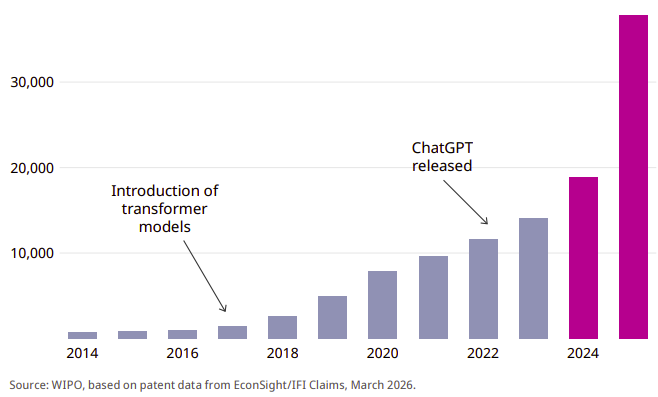
The figure refers to published patent families rather than merely the number of individual national patent publications. A patent family generally groups related patent filings directed to the same or substantially similar invention. Patent-family data can therefore provide a more meaningful measure of distinct inventive activity than a count that treats every national counterpart as a separate invention.
The timing is also important. Patent applications ordinarily are not published immediately after filing. As WIPO explains, the recent increase reflects, at least in part, the closing of the typical approximately 18-month gap between filing and publication following the post-ChatGPT increase in research and development.
Consequently, the patent applications becoming visible today may reflect research and business decisions made well over a year earlier. Current—and still unpublished—filing activity may be even further advanced.
GenAI Is a Growing Share of All AI Patenting Activity
GenAI remains one portion of the broader artificial intelligence patent landscape. Its relative share of AI patenting, however, continues to increase.
According to WIPO:
- GenAI accounted for approximately 4.2% of AI-related patent-family publications in 2017;
- GenAI accounted for approximately 8.7% of all AI patent-family publications in 2025.
The increase indicates that GenAI is not merely growing as part of an overall rise in AI patenting. It is accounting for an increasingly large portion of the broader AI patent landscape.
That distinction matters when companies assess freedom to operate, competitive positioning, and patentability. A technical field experiencing rapid growth can become crowded quickly. Prior-art searches that were reasonably comprehensive only a year or two ago may no longer capture the most relevant patent landscape, particularly as recently filed applications continue to publish.
Patent applicants should therefore avoid treating GenAI as a static technology category. Search strategies, patentability assessments, claim drafting, and competitive analyses may need to be updated throughout product development and prosecution.
Main GenAI Models and Modes
WIPO’s updated data also show that the technological center of gravity within GenAI is changing. The report categorizes GenAI patent families both by the underlying model architecture and by the type—or “mode”—of data the systems process or generate. Viewed together, these categories show a transition from a field once dominated by image-focused generative models toward one increasingly driven by large language models, diffusion models, and multimodal systems with broader commercial applications.
Large Language Models Have Overtaken GANs
The most significant change among GenAI model types is the rise of large language models (LLMs). From 2014 through 2025, approximately 20,900 patent families were published in the LLM category, compared with approximately 18,800 patent families relating to generative adversarial networks (GANs). The speed of this reversal is notable: in 2023, WIPO identified only 881 LLM patent families, compared with 2,370 GAN patent families. By 2025, however, LLM patent-family publications had increased to more than 14,100—nearly three times the approximately 5,245 GAN patent families published that year.
The Figure below illustrates the development of GenAI inventions across five core model categories—large language models, generative adversarial networks, diffusion models, autoregressive models, and variational autoencoders—measured by the number of published patent families from 2014 through 2025.
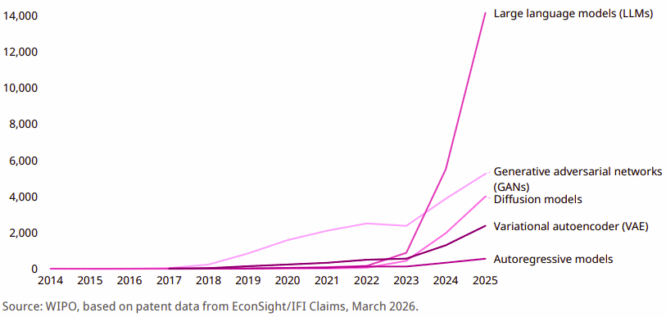
The shift from GANs to LLMs reflects the broader technological evolution of GenAI. GANs were the dominant generative architecture for much of the prior decade, particularly in areas such as image synthesis and data augmentation. Transformer-based architectures underlying LLMs, however, have become central to the current GenAI wave, as the commercial adoption of language and multimodal systems has translated into rapidly increasing patent activity. GANs remain relevant for applications such as image enhancement, synthetic-data generation, and real-time inference, but they no longer occupy the leading position in GenAI patenting.
Diffusion models are also becoming an increasingly important part of the patent landscape. WIPO reports that diffusion-model patent families increased from 441 in 2023 to nearly 4,000 in 2025, making diffusion models the third-largest GenAI model category by cumulative patent volume. Variational autoencoders also experienced substantial growth, while the comparatively limited growth of the separate “autoregressive model” category may reflect applicants’ increasing preference for the more specific and commercially recognizable term “large language model.”
Overall, the model data show that GenAI patenting has moved decisively from a GAN-dominated period toward one led by LLMs and, increasingly, diffusion models. According to WIPO, this development mirrors a broader transition from adversarial image generation toward large-scale language and multimodal systems having wider application potential.
Text and Other GenAI Modes Are Catching Up With Image and Video
WIPO separately categorizes GenAI inventions according to the types of input and output data used by the systems. These modes include image and video, text, speech and audio, software and code, 3D image modeling, and biological information such as molecules, genes, and proteins. Because modern GenAI systems can process multiple types of information, a single patent family may be associated with more than one mode.
Image and video remain the largest GenAI mode by cumulative patent volume. WIPO identified approximately 40,000 image- or video-related patent families published between 2014 and 2025, including more than 13,800 in 2025 alone. This category includes inventions involving multiple model types, including GANs, diffusion models, variational autoencoders, and multimodal LLMs. Its continued lead therefore reflects the broad range of architectures capable of processing or generating visual content.
The Figure below illustrates the development of GenAI inventions across the principal data modes—including image and video, text, speech and audio, software and code, 3D image modeling, and molecules, genes, and proteins—measured by the number of published patent families from 2014 through 2025.
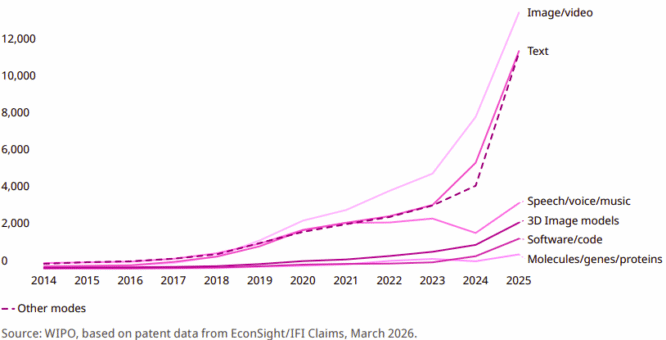
Other modes are also expanding, although from smaller bases. Software- and code-related patent families increased from 339 in 2023 to 1,616 in 2025, reflecting increased patenting activity involving AI-assisted code generation and the integration of GenAI into software-development workflows. Patent families involving 3D image modeling increased from 908 in 2023 to 2,484 in 2025, consistent with growing GenAI applications in virtual environments, gaming, product design, and 3D content creation.
The molecules, genes, and proteins category showed more uneven growth, but WIPO reports that it continues to reflect GenAI’s expanding use in drug discovery, protein design, and other life-sciences applications. Speech, voice, and music patenting also recovered in 2025 after declining during 2024. WIPO suggests that the apparently slower growth of the speech category may partly result from classification practices, because modern audio systems are increasingly implemented through multimodal LLMs and may therefore be classified under text or other modes.
For patent applicants, these trends reinforce the importance of describing both the underlying model architecture and the different data modes that an invention may support. A specification directed only to a single model type or one form of input and output may provide insufficient flexibility as GenAI systems become increasingly multimodal. Where supported by the invention, applications should describe alternative implementations involving text, images, audio, code, and other relevant data types, while also identifying the technical features that distinguish the invention from merely using a conventional GenAI model for an intended result.
From Early-Stage Experimentation to Large-Scale Commercial Deployment
WIPO’s characterization of the field’s transition from experimentation to commercial deployment may be as important as the raw filing numbers.
During an early-stage technology cycle, patent filings often concentrate on foundational models, basic architectures, or proof-of-concept implementations. As commercialization expands, patentable innovation typically becomes more distributed. Inventions may arise not only from the models themselves, but also from the systems used to train, deploy, monitor, secure, validate, and integrate those models.
For GenAI, potentially protectable innovation may occur at multiple layers, including:
- model architecture and training;
- data acquisition, preparation, and governance;
- inference-time processing;
- model orchestration and routing;
- retrieval and contextual-data systems;
- multimodal input and output processing;
- agent-based workflows;
- model evaluation and output validation;
- security, privacy, and access control;
- human-machine interfaces;
- integration with enterprise or industrial systems; and
- application-specific technical improvements.
Not every use of GenAI will produce a patentable invention. Merely applying a known model to a new business objective may face substantial patent-eligibility, novelty, obviousness, or written-description issues. See, e.g., PatentNext: Federal Circuit Rejects AI Claims Lacking Technical Detail (regarding the decision in Recentive Analytics, Inc. v. Fox Corp., No. 2023-2437 (Fed. Cir. Apr. 18, 2025)). But commercial deployment frequently creates technical implementation problems that did not arise—or were not fully appreciated—during early experimentation.
Those implementation problems may themselves lead to patentable solutions. Companies should therefore conduct invention harvesting not only with core AI researchers, but also with engineering, product, security, infrastructure, data, and industry-domain teams responsible for deploying the technology.
GenAI Patenting Is No Longer Limited to Technology Companies
Another important point from WIPO’s announcement is the expanding range of organizations seeking GenAI patent protection.
WIPO reports that GenAI patents are no longer being filed only by conventional technology companies. Large enterprises in finance, telecommunications, infrastructure, and other digital-service industries are also becoming significant participants. WIPO Director General Daren Tang described content generation as the initial impact of GenAI, while identifying its effect on the innovation process itself as a coming frontier.
This expansion has several implications.
First, companies should not assume that their relevant patent competitors are limited to the most visible AI model developers. A financial institution, telecommunications provider, utility, manufacturer, healthcare company, or logistics business may develop patentable GenAI systems tailored to its particular technical environment.
Second, industry-specific data and operational expertise may become increasingly important sources of differentiation. Many companies will use commercially available foundation models. The protectable innovation may instead lie in how those models are integrated into proprietary systems, constrained by operational requirements, supplied with specialized data, or used to improve a technical process.
Third, GenAI patent strategies may increasingly overlap with established patent portfolios in fields such as networking, cybersecurity, industrial control, medical technology, energy management, communications, and enterprise software. Patent teams may need to coordinate GenAI filings with existing technology-specific portfolios rather than treating “AI patents” as a separate and isolated category.
The Growing Strategic Importance of Intellectual Property in the GenAI Economy
WIPO concludes that the latest data underscore the growing strategic importance of intellectual property in the GenAI economy. The organization notes that patent data can help policymakers, businesses, and intellectual-property professionals identify where innovation is accelerating, which technologies are gaining traction, and how competitive dynamics are changing.
Patent information can serve several strategic functions.
For research and development teams, patent data can help identify areas of concentrated innovation and potential white space. For product teams, it can reveal technical approaches being pursued by competitors or adjacent industries. For legal departments, it can inform patentability, freedom-to-operate, licensing, acquisition, and defensive-publication decisions.
Patent data should not be treated as a perfect representation of the market. Companies differ in their reliance on patents, trade secrets, publication, and speed of execution. Patent applications also become public only after a delay. Nevertheless, the scale and direction of filing activity can provide an important indicator of where organizations are committing technical and financial resources.
WIPO’s central message is that decisions being made now about what to protect, where to file, and how to operate in an increasingly crowded field may influence competitive positions for years.
Practical Considerations for GenAI Innovators and Patent Owners
The accelerated filing environment supports several practical steps for businesses developing or implementing GenAI technologies.
1. Establish a Recurring GenAI Invention-Harvesting Process
A single annual invention-review meeting may be insufficient for a field changing as rapidly as GenAI.
Companies should consider recurring invention-harvesting sessions with personnel involved in model development, data engineering, software architecture, cybersecurity, product deployment, and industry-specific implementation. The review should focus on technical problems solved during development—not merely on whether the project uses AI.
Questions may include:
- What technical limitation did the development team encounter?
- Why were available models or platforms inadequate?
- What changes were made to improve accuracy, latency, reliability, security, or resource utilization?
- Was a new architecture, data structure, workflow, or control mechanism developed?
- Could a competitor implement the same result using a different model or platform?
- Which aspects should remain confidential, and which should be patented?
Because patent publication data lag behind filing activity, waiting until competitors’ portfolios become visible may leave a company reacting to strategies adopted many months earlier.
2. Focus Patent Applications on Technical Differentiation
A patent application should not rely solely on labels such as “generative AI,” “large language model,” or “machine learning.”
The application should explain the relevant technical architecture, inputs, processing steps, system interactions, and resulting improvements. Where applicable, it should describe how the claimed technology improves computer operation, data processing, network performance, model execution, security, industrial control, or another technical process. See, e.g., PatentNext: Artificial Intelligence (AI) Patenting Handbook: Version 3.0.
The goal is to identify what the company actually invented—not merely the commercially attractive result produced by the system.
3. Draft Specifications That Can Accommodate Technological Change
Model terminology and preferred architectures can change rapidly. A specification drafted around only one currently popular model may become unnecessarily narrow as the technology develops.
Where supported by the invention, the specification should describe alternative model types, deployment arrangements, data sources, processing sequences, and implementation mechanisms. It should also distinguish between features that are essential to the invention and features that are merely examples.
This approach can provide flexibility during prosecution and reduce the risk that claims become obsolete when a particular model, platform, or architecture is replaced.
4. Use a Layered Claim Strategy
A GenAI patent application may benefit from claims directed to different levels of the technology.
Independent claims may address the core technical process or system architecture. Dependent claims may address narrower implementations, including particular model types, retrieval techniques, agent workflows, validation mechanisms, data structures, interfaces, security controls, or deployment environments.
Claims should also be considered across appropriate statutory forms, such as system, method, and computer-readable-medium claims. Depending on the invention, additional claims may address training, inference, deployment, monitoring, or interaction with physical systems.
A layered approach can provide both broader commercial coverage and narrower fallback positions during prosecution.
5. Coordinate Patent Protection With Trade-Secret Strategy
Not every GenAI innovation should necessarily be patented.
Certain training techniques, datasets, model parameters, evaluation procedures, or internal deployment practices may be difficult for competitors to observe and may therefore be candidates for trade-secret protection. Other innovations may be visible in a product, discoverable through testing, or likely to be independently developed, making patent protection more important. See, e.g., PatentNext: AI-based Inventions: Patenting vs. Trade Secret Considerations.
The decision should be made deliberately. It should account for detectability, reverse engineering, employee mobility, publication risk, enforceability, and the expected commercial life of the technology.
6. Monitor Both Traditional and Nontraditional Competitors
As GenAI patenting expands across industries, competitive monitoring should extend beyond well-known AI and software companies.
A business may encounter relevant patents owned by customers, suppliers, infrastructure providers, universities, research institutions, or companies in adjacent industries. Patent monitoring should therefore be organized around relevant technologies and technical functions, not only around a fixed list of competitors.
Conclusion
WIPO’s latest data confirm that GenAI patenting has moved into a period of exceptional growth. More than 56,000 GenAI patent families were published during 2024 and 2025—more than during the entire preceding decade—and GenAI now represents an increasing share of all AI-related patent activity.
The growth also reflects a broader change in the market. GenAI innovation is moving from early experimentation toward large-scale commercial deployment, and patent ownership is expanding beyond traditional technology companies into finance, telecommunications, infrastructure, and other industries.
For businesses, the practical lesson is not simply to file more patents. It is to identify technical innovation earlier, draft applications with sufficient implementation detail, preserve flexibility for changing architectures, coordinate patent and trade-secret protection, and monitor a rapidly evolving competitive landscape.
In a field moving this quickly, patent strategy cannot be separated from product and business strategy. The organizations that develop disciplined processes for identifying and protecting GenAI innovation now may be better positioned as today’s experimental systems become tomorrow’s commercial infrastructure.
****
Subscribe to get updates to this post or to receive future posts from PatentNext. Start a discussion or reach out to the author, Ryan Phelan, at rphelan@marshallip.com or 312-474-6607. Connect with or follow Ryan on LinkedIn.