
PatentNext Summary: The USPTO issued “Reminders” for examiners in Tech Centers 2100/2600/3600 addressing §101 eligibility for software and Artificial Intelligence(AI) / Machine  Learning (ML)-related inventions; while not changing the MPEP, the guidance is meant to sharpen examination practice. It clarifies Step 2A, Prong One by limiting “mental process” to what can be practically performed in the human mind—stating that AI claim limitations not performable mentally are not “mental processes”—and by distinguishing claims that merely involve a judicial exception (e.g., Example 39) from those that recite one (e.g., Example 47). For Step 2A, Prong Two, examiners must evaluate the claim as a whole to identify a practical application, giving weight to meaningful additional limitations and to improvements in computer capabilities or a technical field, even if the improvement is only implicit in the specification. The Reminders caution against oversimplified “apply it” rejections, require a preponderance of evidence for “close call” §101 rejections, and reinforce compact prosecution that fully addresses §§102/103/112 for every claim in the first action.

Continue Reading USPTO Issues “Reminders” Supporting AI and Software Patenting and instructing Patent Examiners on the Limits of Section 101 Patent Eligibility 

PatentNext Summary: Recent rulings from the Northern District of California in Bartz v. Anthropic and Kadrey v. Meta provide the first substantive guidance on how the fair use doctrine applies to AI training, particularly for large language models (LLMs). Both courts found that using lawfully obtained copyrighted books for LLM training can qualify as “highly

PatentNext Summary: In Brightex Bio-Photonics, LLC v. L’Oreal USA, Inc., the U.S. District Court for the Northern District of California invalidated patent claims relating to AI-driven cosmetic recommendations, finding them directed to an abstract idea under 35 U.S.C. § 101. The court held that while the specification referenced artificial intelligence, the claims themselves failed

PatentNext Summary: In two recent decisions, the Federal Circuit reaffirmed that merely applying artificial intelligence or digital techniques to a specific “field of use” does not satisfy patent eligibility under 35 U.S.C. § 101. In Recentive Analytics v. Fox Corp., claims directed to AI-assisted television scheduling were deemed abstract for lacking inventive implementation. Similarly, in

PatentNext Summary: The Federal Circuit’s decision in Recentive Analytics, Inc. v. Fox Corp. found that applying generic machine learning techniques to a new environment, without a specific technological improvement, is patent-ineligible under 35 U.S.C. § 101. The court emphasized that claims must articulate concrete technological advancements rather than merely applying established methods to different domains.

Agentic AI is transforming artificial intelligence by enabling systems to act independently, making decisions and solving problems autonomously across various industries. Its potential rapid development poses unique challenges for intellectual property protection, requiring innovative strategies to ensure these advancements are effectively safeguarded within the evolving IP landscape.

Continue Reading Agentic AI: Transforming Industries and Navigating the Patent Frontier

PatentNext Summary: Generative Artificial Intelligence (GenAI) patent application filings continue to rise at the U.S. Patent and Trademark Office (USPTO), with a significant concentration in Tech Center 2100, which focuses on computer architecture and software, particularly AI and simulation technologies. GenAI inventions commonly face Section 103 (obviousness) and Section 101 (subject matter eligibility) rejections, with

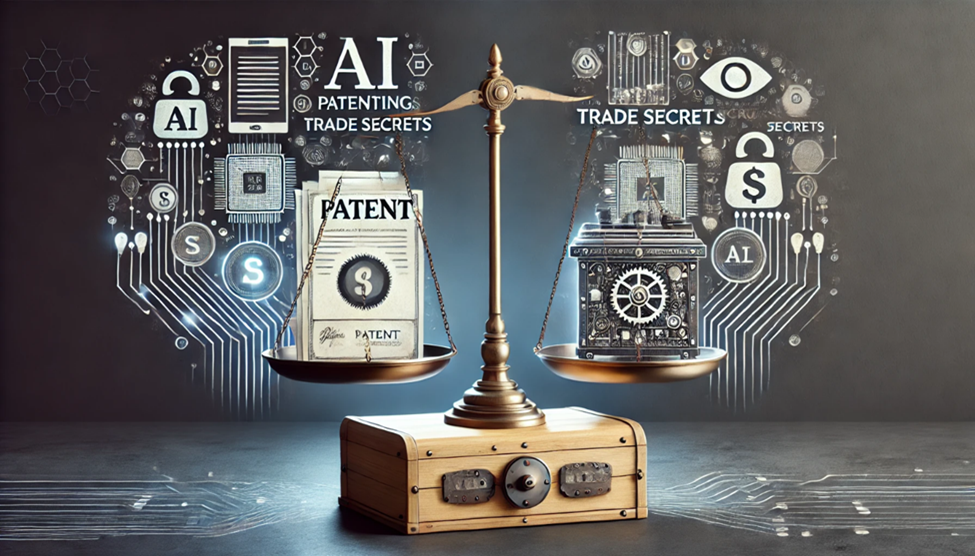
PatentNext Takeaway: When deciding whether to patent AI-based inventions or maintain them as trade secrets, key considerations include the extent of public disclosure and the detectability of the AI model. Deploying an AI model in consumer-facing devices or making its output public often supports patenting to secure exclusivity. On the other hand, low detectability and sensitive training data, such as personal or medical information, may favor trade secret protection. Balancing these factors alongside the need for sufficient disclosure to meet patent requirements allows businesses to safeguard their innovations while mitigating risks.

Continue Reading AI-based Inventions: Patenting vs. Trade Secret Considerations

PatentNext Takeaway: This post highlights the FDA’s increasing regulatory efforts for artificial intelligence (AI) and machine learning (ML)-enabled medical devices (MLMDs), with a focus on managing device AI/ML updates through Predetermined Change Control Plans (PCCPs). The FDA emphasizes five guiding principles for PCCPs to ensure safety, risk management, and transparency for MLMDs throughout their lifecycle.

PatentNext Takeaway:  WIPO published a Patent Landscape Report on GenAI.  The Patent Landscape Report discusses trends in GenAI, including trends in: GenAI scientific publications, GenAI patents, GenAI models, types of data used in GenAI, and GenAI application areas.

Continue Reading WIPO Issues a Patent Landscape Report on Generative AI