
Recent headlines suggest that prominent technology CEOs are tossing tepid water onto the quantum computing narrative, leading to a sell-off of quantum computing stocks in January 2025. However, quantum computing CEO’s disagree, asserting that commercial quantum computers are already here and delivering value to clients. While the timeline for widespread quantum utility remains debated, one thing is undeniable: innovation in quantum computing is accelerating, and the evidence is clearly visible in the patent landscape. Understanding these patent trends offers a valuable, albeit early, glimpse into the technologies being developed, the companies leading the charge, and the potential challenges along the way. Just as provisional patent applications filed as far back as the launch of the iPhone in 2007 foreshadowed Apple’s release of the Vision Pro headset in February of 2024, the current quantum computing patent activity hints at the future direction of this transformative field. See U.S. Patent No. 15/972,985 incorporating by reference U.S. App. No. 60/927,624 and U.S. App. No. 61/010,126.

What is a Quantum Computer? Moving Beyond Bits to Qubits

To understand the difference between a classical computer and its quantum counterpart it may be useful to think of a classical computer like a light switch. The light switch can be either ON, representing a 1, or OFF, representing a 0. These 0s and 1s, called bits, are the foundation of all the computations that modern classical computers perform.

Now, imagine a dimmer switch instead of a simple on/off switch. A quantum computer leverages qubits that, unlike bits, are not strictly 0 or 1. Rather qubits can exist in a state of superposition. Think of it this way: a qubit can be both 0 and 1 at the same time, or anywhere in between, until it is physically measured. This “both at once” state is the superposition, and it dramatically expands the possibilities for computation. Qubits can also be linked together through entanglement, a quantum phenomenon where their “fates” are intertwined. As an example imagine these entangled qubits are actually two coins that are linked. Even if you separate them by a vast distance, flipping one coin and reading whether it is heads or tails also instantly determines the outcome of the other coin. Thus their “fates” are intertwined and they act as a single system, no matter how far apart they are. This interconnectedness further amplifies their computational power.

Because of superposition and entanglement, quantum computers can explore vast computational spaces far more efficiently than classical computers for certain types of problems. While classical computers tend to tackle problems step-by-step, quantum computers can explore many possibilities simultaneously. This gives them the potential to solve problems that are infeasible for even the most powerful supercomputers.

Overall Quantum Computing Patent Filing Trends in the US

Graph | Quantum computing patent filings in the US between 2002 - 2024

Figure 1: Quantum Computing Patent Filings in the US Over Time

Figure 1 illustrates the overall trend of quantum computing patent filings in the United States. The number of filings started to increase dramatically in the mid-2010s. However, the most recent data points for 2023 and 2024 may appear to show a decrease but it is crucial to interpret this in light of the ~18 month publication delay at the USPTO. Therefore, the filings for the most recent years are still underrepresented in this data, as many applications filed in 2023 and most filed in 2024 are yet to be published. Regardless, the overall trend clearly indicates a robust and rapidly expanding field of innovation within quantum computing.

Top Quantum Computing Modalities: Patent Filing Trends

While the overall quantum computing patent landscape shows strong growth, examining trends within specific physical realization methods, or “modalities,” provides a more granular understanding of the innovation landscape. Here, we delve into the patent filing trends for some of the top modalities, based on our analysis of patent activity: Superconducting, Annealing, Topological, Photonic, Trapped Ion, and Quantum Dot.Rejection Type Analysis: Navigating Patent Prosecution Challenges

Beyond filing trends, understanding the types of rejections faced by quantum computing patent applications is crucial for strategic patent prosecution. Analyzing rejection data provides insights into the patentability hurdles specific to this technology area. Here, we examine the distribution of rejection types for quantum computing patents in the US.

Graph | Six illustrations comparing patent application to publication delay

Examining patent filing trends across six quantum computing modalities (Figures 2-7) reveals a nuanced picture of innovation within the field, marked by a noticeable difference in scale. Superconducting (Figure 2) and Quantum Annealing (Figure 3) stand out with substantially higher patent filing volumes, with their y-axes scale depicted up to 80, indicating a significantly greater level of patenting activity compared to the other modalities with their y-axes scale depicted up to 15. Both Superconducting and Quantum Annealing demonstrate robust and sustained upward trajectories, suggesting consistent and major investment in these areas. In contrast, Topological (Figure 4), Photonic (Figure 5), Trapped Ion (Figure 6), and Quantum Dot (Figure 7) quantum computing exhibit considerably lower patent filing volumes. These modalities show more gradual filing patterns: Photonic and Trapped Ion display steady, albeit moderate, growth, while Topological and Quantum Dot are characterized by lower overall patent activity. This disparity in scale may reflect the relative maturity, investment levels, and perceived near-term commercial viability of Superconducting and Annealing technologies compared to the other modalities.

Overall Rejection Type Distribution

Bar chart | Distribution of rejection types for quantum computing patents

Figure 8: Distribution of Rejection Types for Quantum Computing Patents

Figure 8 presents the overall distribution of rejection types for quantum computing patent applications. As anticipated in many technology fields, 35 U.S.C. § 103 rejections based on obviousness are the most frequent, accounting for approximately 30% of all rejections. However, a significant portion of rejections also fall under 35 U.S.C. § 101 concerning subject matter eligibility, representing approximately 15% of rejections. The USPTO’s interpretation of § 101, particularly in the context of abstract ideas and laws of nature, can pose challenges for quantum inventions that may involve algorithms, mathematical methods, or fundamental quantum principles. 35 U.S.C. § 102 rejections for anticipation account for approximately 20% of rejections, indicating that a substantial number of quantum patent applications are being rejected based on prior art that anticipates the claimed invention. 35 U.S.C. § 112(b) rejections for definiteness, also around 20%, suggesting challenges in clearly and precisely defining the scope of quantum inventions in patent claims.

PTAB Case Study: Ex parte Cao – A Victory on Written Description and Subject Matter Eligibility

A recent Patent Trial and Appeal Board (PTAB) decision in Ex parte Cao (Appeal No. 2024-002159) illustrates the challenges and nuances of patent prosecution in quantum computing, particularly concerning 35 U.S.C. § 101 and § 112(a).

In Ex parte Cao, the applicant appealed a Final Rejection that included both § 112(a) Written Description and § 101 Subject Matter Eligibility rejections. The invention related to a hybrid quantum-classical computer system designed for solving linear systems of equations. The proposed system combined classical and quantum computers to leverage their respective strengths in tackling complex mathematical problems. The claims focused on a method and system for preparing a specific “quantum state” that approximated the solution, utilizing a “cleverly designed objective function.”

The Examiner argued that the specification lacked adequate written description for the broad claim term “generating an objective function that depends on . . .” under § 112(a), asserting that the specification provided only limited examples and did not sufficiently describe the genus of objective functions claimed. Furthermore, the Examiner contended under § 101 that the claims were directed to an abstract idea – a mathematical method for solving linear equations – and lacked the requisite “significantly more” to establish patent eligibility, even with the inclusion of quantum and classical computers in the claims.

In a significant win for the applicant, the PTAB reversed the Examiner’s rejections on both grounds.

1. Written Description – Specification Examples Can Be Key for Genus Claims:

The PTAB overturned the § 112(a) rejection, finding the specification did adequately describe the claimed invention. The PTAB’s key reasoning included:

  • Specification Provided Examples: The specification detailed specific “objective functions” and provided “specific implementation examples.”
  • Functional Characteristics Sufficient: While the claims used functional language (“generating an objective function that depends on . . .”), the PTAB found that the specification, by providing examples and defining the characteristics of a suitable objective function, sufficiently conveyed to a PHOSITA that the inventor possessed the claimed genus.
  • Distinguishing Vasudevan Software: The PTAB distinguished the case from precedent like Vasudevan Software, Inc. v. MicroStrategy, Inc., where claims lacked specification support. In Ex parte Cao, the claims were tied to specific elements described in the specification.

When drafting claims with broad, functional limitations, particularly in complex technologies like quantum computing, robust specification support is necessary. Practitioners should not merely repeat claim language in the specification. Practitioners should provide concrete examples and clearly describe the characteristics and functionality. This can be sufficient to establish written description, even for genus claims.

2. Subject Matter Eligibility (§ 101) – Focus on Technological Improvement and Practical Application:

The PTAB also reversed the § 101 rejection, finding the claims were not directed to an abstract idea. The PTAB’s reasoning emphasized demonstrating a technological improvement and practical application in computer-implemented inventions:

  • Quantum Computer as More Than a Generic Tool: The PTAB rejected the Examiner’s view of the quantum computer as simply a generic tool for mathematical calculations. They recognized that the inclusion of a “quantum computer, controlling a plurality of qubits . . . to prepare a quantum state” was not just “recitation of gathering data.”
  • Integration into Practical Application: The PTAB found this element “represents the focus of the invention and integrates the recited abstract idea into a practical application.”
  • Technology Improvement – Enabling Noisy Quantum Computers: The PTAB agreed with the Applicant that the invention provided a “technology improvement” by “enabling noisy quantum computers, which have limited circuit depth, to practically solve linear systems.” They cited the specification’s description of prior art limitations and the invention’s solution.

To overcome § 101 rejections, especially in software and computer-related inventions, practitioners should clearly articulate and emphasize the technological improvement and practical application provided by the invention. By showing how the invention improves the technology itself, solves a technical problem, or provides a tangible benefit in a practical field practitioners can overcome pesky § 101 rejections.

Implications for Patent Attorneys:

  • Detailed Specification is Paramount: Ex parte Cao underscores the critical importance of a well-drafted specification, rich with examples and detailed descriptions, especially when claiming complex technologies.
  • Focus on Technological Advancement: When facing § 101 rejections, frame your arguments around the technological improvement and practical application of the invention. Highlight how it solves a real-world problem and advances the state of the art.
  • PTAB Reversals are Possible: Even in complex cases with challenging rejections, a well-reasoned appeal brief, focusing on the legal principles and supported by the specification, can lead to a successful PTAB reversal.

While quantum computing may seem esoteric, the principles illustrated in Ex parte Cao are applicable and relevant to patent attorneys in various fields. By focusing on detailed specification support and clearly articulating the technological advancements of your client’s inventions, you can significantly increase your chances of overcoming Examiner rejections and securing valuable patent protection.

Data Source and Methodology

Please note that the charts and related information in this article were generated using information provided courtesy of Juristat. The patent data was obtained using custom keyword searches in the Juristat patent analytics platform.

Overall Quantum Computing Trends: The overall quantum computing patent filing trends were generated using the search query: “quantum computer”|”quantum computing”|”qubit”. Where | represents an OR operator.

Modality-Specific Trends: The patent filing trends for each of the six quantum computing modalities (Superconducting, Annealing, Topological, Photonic, Trapped Ion, and Quantum Dot) were generated using modality-specific keyword search queries. These queries included combinations of terms related to each modality, such as qubit types, technology names, and associated terminology.

Search Fields: Searches were conducted within the Title, Abstract, and Claims fields of patent applications.

Rejection Type and Tech. Center Breakdown by Modality Appendix

The following table provides a breakdown of rejection types by modality, offering a more detailed view of the patent prosecution challenges for each technology.

Bar Chart | Rejection type by modality appendix.

Appendix Figure 9: Rejection Type Breakdown by Modality

While the overall rejection distribution provides a general overview, examining rejection types by modality reveals further nuances. Some interesting findings:

  • Superconducting Quantum Computing patents tend to face a higher proportion of 102 (Anticipation) and 103 (Obviousness) rejections compared to 101 rejections. This might suggest that for this more mature modality, the focus of patent examination is more on novelty and nonobviousness over prior art, rather than fundamental subject matter eligibility.
  • Quantum Annealing patents, in contrast, exhibit a notably higher percentage of 101 (Subject Matter Eligibility) rejections. This is likely due to the nature of annealing inventions, which often involve algorithms, optimization methods, and system architectures that may be scrutinized for abstractness under § 101.
  • Topological Quantum Computing patents show a significantly elevated percentage of 112(a) rejections (Written Description and Enablement). This highlights the challenges in adequately describing and enabling these complex, cutting-edge inventions in patent applications, likely due to the theoretical and nascent stage of the technology.
  • Trapped Ion Quantum Computing patents display a higher percentage of 112(b) rejections (Definiteness), suggesting difficulties in clearly defining the scope of claims related to intricate ion trap systems and control methods.

In a recent PTABWatch article titled “PTAB Provides Some Clarity on Artificial intelligence (AI) Obviousness in IPR decision,” the PTAB’s approach to evaluating obviousness in AI-related patents is examined.  The article discusses the case Tesla, Inc. v. Autonomous Devices, LLC, where the PTAB invalidated all challenged claims of U.S. Patent Number 11,055,583, which pertained to an AI system for autonomous device operation.  The decision offers valuable insights into how prior art is assessed in the context of AI innovations.  Read the full article on PTABWatch.

Agentic AI is transforming artificial intelligence by enabling systems to act independently, making decisions and solving problems autonomously across various industries. Its potential rapid development poses unique challenges for intellectual property protection, requiring innovative strategies to ensure these advancements are effectively safeguarded within the evolving IP landscape.

Continue Reading Agentic AI: Transforming Industries and Navigating the Patent Frontier

PatentNext Summary: Generative Artificial Intelligence (GenAI) patent application filings continue to rise at the U.S. Patent and Trademark Office (USPTO), with a significant concentration in Tech Center 2100, which focuses on computer architecture and software, particularly AI and simulation technologies. GenAI inventions commonly face Section 103 (obviousness) and Section 101 (subject matter eligibility) rejections, with the latter being a frequent challenge for computer-related inventions. Despite this, Tech Center 2100 boasts a relatively high allowance rate of 79%, while other centers, like 2600 and 2400, achieve even higher rates of up to 97%. Avoiding Tech Center 3600, known for its stringent Section 101 rejections, remains a strategic consideration for inventors seeking patent protection. 

****

For the years leading up to the end of 2024, the United States Patent and Trademark Office (USPTO) experienced a surge in filings for Generative AI (GenAI) inventions.

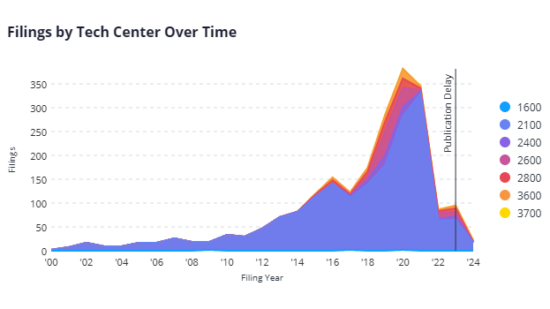
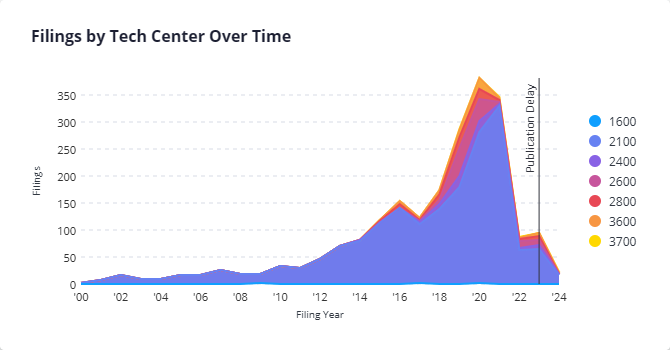
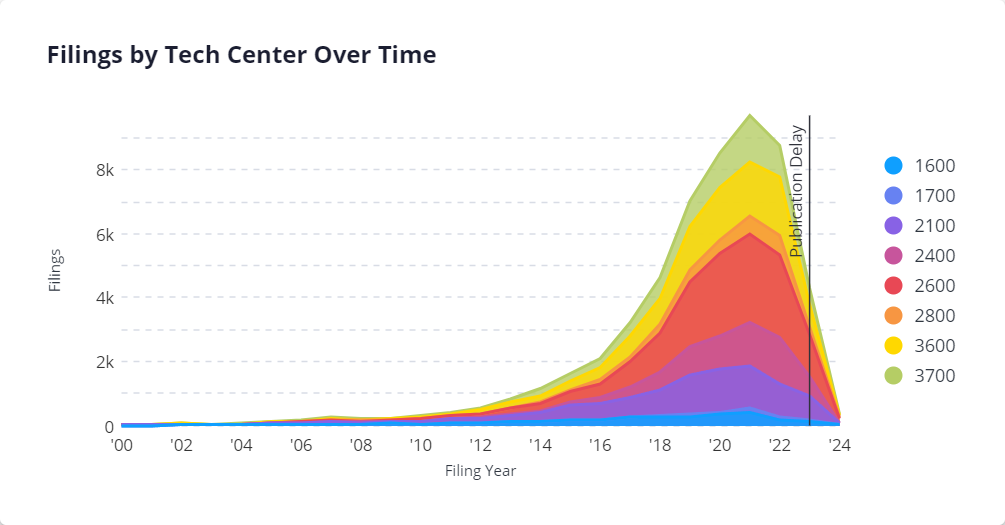
The chart below illustrates filings by Technology (“Tech”) Center over time, spanning from 2000 to 2024.

It is important to note that the downward slope on the right-hand side of the graph is due to the 18-month “Publication Delay,” during which information about newer patent application filings is not yet publicly available. See 37 CFR § 1.211.

This chart organizes patent application filings by Tech Center. As shown, the majority of AI-related patent applications are concentrated in Tech Center 2100 (represented by the dark blue color in the graph), which covers “Computer Architecture and Software” inventions. This is unsurprising, as Tech Center 2100 encompasses Art Unit 2120, which focuses on “AI & Simulation/Modeling.”

Tech Center 2100 received most of the AI-related patent application filings. For instance, in 2021, Tech Center 2100 accounted for 337 GenAI-related invention filings, while the remaining Tech Centers each handled five or fewer such filings.

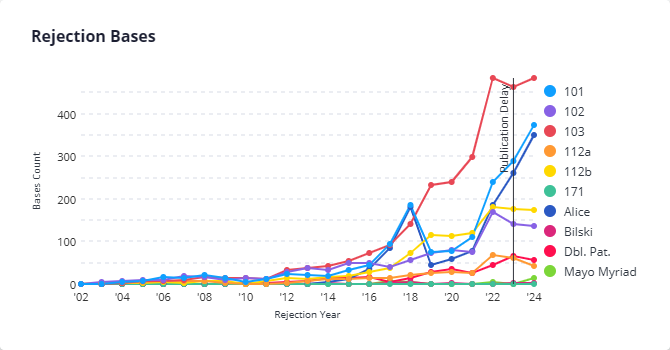
The graph below highlights the rejection bases for GenAI-related patent applications. 

Graph | Rejection bases count relative to rejection year between 2002 and 2024

As expected, GenAI-related inventions most commonly faced Section 103 (obviousness) rejections. However, Section 103 rejections are generally the most common type of rejection across all categories.

Additionally, the graph shows that Section 101 (Subject Matter Eligibility) rejections were the second most common for GenAI inventions. Section 101 rejections are prevalent in computer-related inventions, a category that includes GenAI.

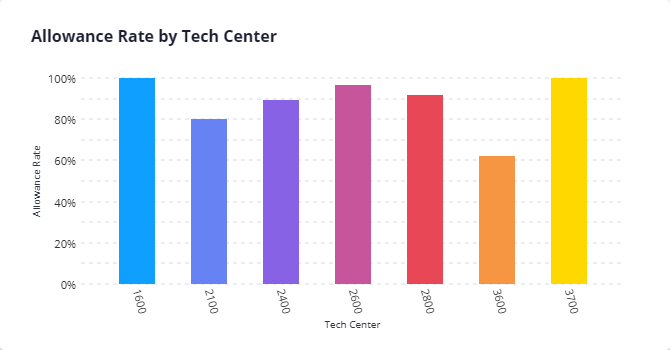
Despite these challenges, there is encouraging news for GenAI inventors. The two most common Tech Centers (2100 and 2600) boast high allowance rates. The chart below outlines patent application allowance rates by Tech Center. 

Bar Chart | Allowance rate by tech centers

As seen above, GenAI-related patent applications reviewed by examiners in Tech Center 2100 (dark blue bar) achieved a relatively high allowance rate of 79%. Other Tech Centers, such as 2400 and 2600, perform even better, with allowance rates of 90% and 97%, respectively.

In contrast, Tech Center 3600 (orange bar) handles a mix of business-related technologies, including “Transportation, Construction, Electronic Commerce, Agriculture, National Security, and License and Review.” Certain Art Units within Tech Center 3600, such as Art Unit 3620 (“Business Methods”), are notorious for issuing patent-eligibility rejections under 35 USC § 101. These rejections can be challenging to overcome, contributing to the lower allowance rate of 63% for this Tech Center.

As such, avoiding Tech Center 3600 remains a prudent strategy for patentees.

For further guidance on this approach, readers can explore PatentNext’s articles on best practices for patenting AI inventions. See How to Patent an Artificial Intelligence (AI) Invention: Guidance from the U.S. Patent Office (USPTO) and How to Patent Software Inventions: Show an “Improvement”.

****

Please note that the charts and their related information in this article are provided courtesy of Juristat. The charts and information were obtained by searching for search terms (“generative artificial intelligence” OR “Large Language Model” OR “Transformer” OR “diffusion”) using the fields Title, Abstract, and Claims and the filters USPC 706 (“Data processing: artificial intelligence”) and CPC G06N (“Computing Arrangements Based On Specific Computational Models”) in the Juristat app.

Subscribe to get updates to this post or to receive future posts from PatentNext. Start a discussion or reach out to the author, Ryan Phelan, at rphelan@marshallip.com or 312-474-6607. Connect with or follow Ryan on LinkedIn.

PatentNext Takeaway: When deciding whether to patent AI-based inventions or maintain them as trade secrets, key considerations include the extent of public disclosure and the detectability of the AI model. Deploying an AI model in consumer-facing devices or making its output public often supports patenting to secure exclusivity. On the other hand, low detectability and sensitive training data, such as personal or medical information, may favor trade secret protection. Balancing these factors alongside the need for sufficient disclosure to meet patent requirements allows businesses to safeguard their innovations while mitigating risks.

Continue Reading AI-based Inventions: Patenting vs. Trade Secret Considerations

This article is co-authored by Phelan Simpkins, counsel for State Farm who oversees emerging technology licenses, among other key areas for the company. Phelan is speaking in his individual capacity. The views expressed herein do not necessarily reflect the view and position of State Farm.

PatentNext Takeaway: This post discusses the issues of divided infringement in U.S. patent law, specifically focusing on software-based patent claims. Divided infringement occurs when multiple parties collectively perform all the steps of a patent claim, but no single party carries out every element. This is particularly problematic for software patents, where actions can be split between different entities. This post reviews key case law, such as Akamai Techs. v. Limelight Networks and Travel Sentry v. Tropp, which illustrate scenarios where divided infringement disputes arise. The post emphasizes that patent drafters should focus on drafting claims that assign all essential steps or components of a system to a single entity to avoid costly litigation. This strategy helps ensure enforceability and minimizes the complexities of proving infringement when multiple actors are involved. This post concludes with best practices for drafting patent claims, encouraging practitioners to structure claims in ways that simplify enforcement and reduce reliance on third-party actions.

****

Continue Reading Drafting Software-based Patent Claims to Avoid Costly Divided Infringement Issues

PatentNext Takeaway: This post highlights the FDA’s increasing regulatory efforts for artificial intelligence (AI) and machine learning (ML)-enabled medical devices (MLMDs), with a focus on managing device AI/ML updates through Predetermined Change Control Plans (PCCPs). The FDA emphasizes five guiding principles for PCCPs to ensure safety, risk management, and transparency for MLMDs throughout their lifecycle. The post also notes a significant rise in AI-based medical device FDA submissions and related patent filings, particularly since 2016, indicating growing interest in this technology.

****

Introduction

The Food and Drug Administration (FDA) continues to engage in regulatory efforts for Artificial Intelligence (AI) and machine learning (ML) based software devices, which the FDA refers to as artificial intelligence/machine learning-enabled medical devices (MLMD). This article serves as an update to those efforts, as previously discussed on PatentNext. See PatentNext: The Intersection of Artificial Intelligence (AI), Life Sciences, Healthcare, and Intellectual Property (IP)

AI-based Medical Device FDA Filings

Innovators of AI-based medical device inventions should familiarize themselves with the regulatory landscape, including the FDA’s position on Artificial Intelligence (AI) and machine learning (ML) based software devices, including MLMDs. 

The FDA has identified AI/ML as an important technology that it will monitor and regulate, stating that “AI/ML technologies have the potential to transform health care by deriving new and important insights from the vast amount of data generated during the delivery of health care every day,” and that “[t]he FDA may also review and clear modifications to medical devices, including software as a medical device, depending on the significance or risk posed to patients of that modification.” Artificial Intelligence and Machine Learning in Software as a Medical Device” (FDA.gov).

The FDA maintains a list of AI/ML-enabled Medical devices submitted to the FDA. The list includes devices submitted and authorized via 510(k) clearance, granted De Novo request, or an approved Premarket Approval Application (PMA). 

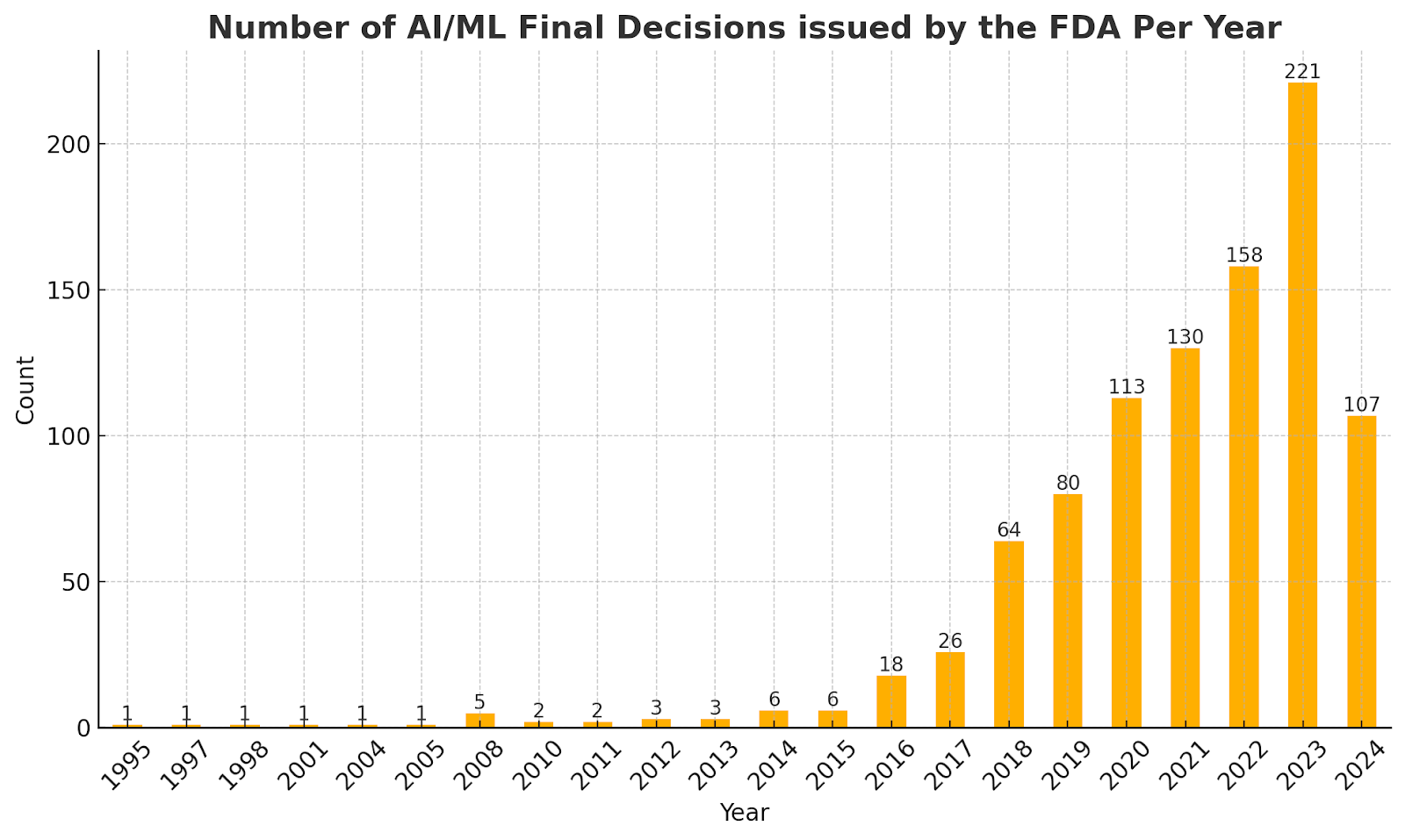
The chart below summarizes the number of AI/ML submissions made to the FDA through the years. 

Chart 1: Number of AI/ML Final Decisions by the FDA Per Year

Bar Chart | Comparing number of AI/ML final decisions by the FDA per year between 1995 and 2024.

As shown in the above Chart 1, AI/ML decisions started increasing exponentially around the 2016 timeframe. This correlates with AI-medical device patent filings, as shown below in this article.

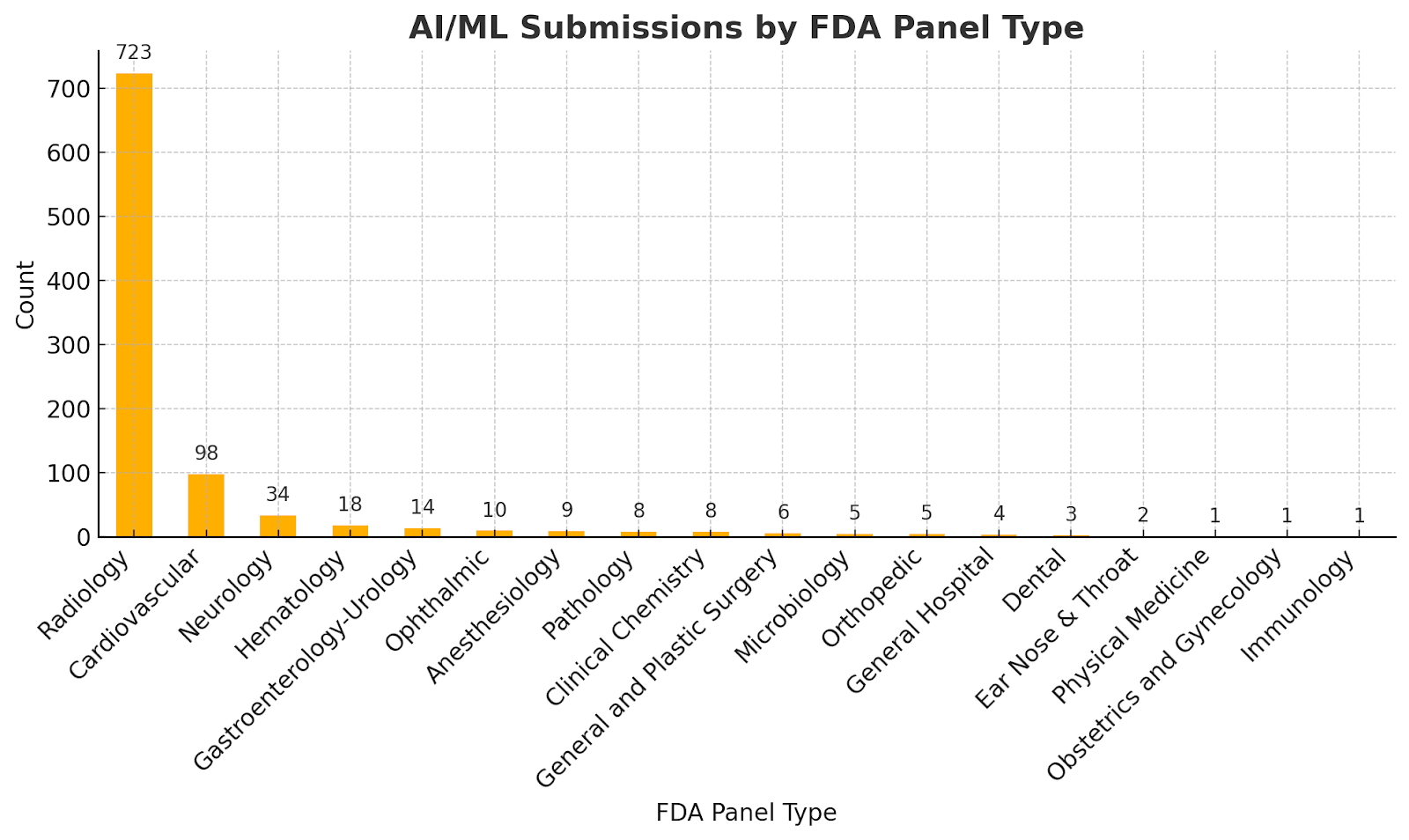
As shown in the below Chart 2, by far, the Radiology FDA panel received the most submissions (723 submissions) compared to any other group. The Cardiovascular FDA panel received the second most submissions (98 submissions). The remaining panels each received 35 or fewer submissions. 

Chart 2: AI/ML Submissions by FDA Panel Type

Bar Chart | Comparing AI/ML Submissions by FDA Panel Types to number submitted.

The FDA’s Predetermined Change Control Plans (PCCPs) for updating AI/ML-enabled medical devices 

Even after being initially approved by the FDA, an AI/ML-enabled medical device may be subject to additional approval when its AI model is updated. This is because an update to a medical device’s underlying AI model may cause the AI model, and thus the AI/ML-enabled medical device, to operate differently from when it was originally approved by the FDA.

The FDA acknowledges that traditional medical device regulation wasn’t designed to address technology that can update an already approved device, e.g., “The FDA’s traditional paradigm of medical device regulation was not designed for adaptive artificial intelligence and machine learning technologies. Many changes to artificial intelligence and machine learning-driven devices may need a premarket review.” “Artificial Intelligence and Machine Learning in Software as a Medical Device” (FDA.gov).

Further, the FDA acknowledges that changes to an AI model deployed on an approved AI medical device can be significant, e.g., “certain changes to [machine learning-enabled medical devices] MLMDs, such as changes to a model or algorithm, may be substantive or significant. For this reason, they can require regulatory oversight, such as additional premarket review. Such regulatory expectations may not always coincide with the rapid pace of MLMD development.” Predetermined Change Control Plans for Machine Learning-Enabled Medical Devices: Guiding Principles (FDA.gov).

In order to address this issue, the FDA has released a set of five (5) “guiding principles” to manage and monitor MLMDs, having deployed AI models for performance and re-training risks. Id. The FDA looks to these five guiding principles to develop or review Predetermined Change Control Plans (PCCPs). 

The 5 Guiding Principles for developing a PCCP are summarized below.

1. Focused and Bounded: A PCCP should describe specific changes that a manufacturer intends to implement. Such changes should be limited to modifications within the intended use or intended purpose of the original MLMD.

2. Risk-based: A PCCP should be driven by a risk-based approach throughout the MLMD’s product lifecycle to ensure that individual and cumulative changes remain appropriate over time for the MLMD and its use environment.

3.  Evidence-Based: A PCCP should involve collection/monitoring evidence to ensure the ongoing safety and effectiveness of the MLMD, demonstrate that the benefits outweigh the associated risks, and establish that the risks are adequately managed and controlled.

4. Transparent: A PCCP should provide transparency to users and/or stakeholders of the MLMD by, e.g., characterization of data used in the development and modifications of a model deployed on the MLMD, comprehensive testing for planned changes, characterization of the MLMD before and after implementation of changes, and monitoring, detection, and response to deviations in MLMD performance.

5. Total Product Lifecycle (TPLC) Perspective: A PCCP should consider the lifecycle of the product by employing risk management practices during the lifecycle of the MLMD and by using and supporting existing regulatory, quality, and risk management measures throughout the TPLC to ensure device safety by monitoring, reporting and responding to safety concerns.

Currently, the 5 Guiding Principles do not replace existing FDA regulatory procedures or constitute approval of any updated AI/ML-enabled Medical device. Instead, the 5 Guiding Principles are to “facilitate and foster ongoing engagement and collaboration among stakeholders on the PCCP concept for MLMD” and to “lay a foundation for PCCPs and encourage international harmonization.” Id.

AI-based Medical Device Patent Filings

The number of AI-based Medical Device Patent filings follows a similar trend compared to the number of AI/ML submissions made to the FDA, as shown above in Chart 1.

For example, the below chart shows AI and Life Science patent filings by Technology (“Tech”) Center over time from 2000 to 2024, where a spike exists in filing activity post-2016 (note that the right-most side of the graph slopes downward because of the 18-month “Publication Delay,” during which information for newer patent application filings, is not yet publicly available. See 37 CFR § 1.211).

Graph | Filings by tech centers from 2000 to 2024 compared to publications delay.

The above chart is provided courtesy of Juristat. The chart and information were obtained by searching for “software AND medical AND device AND (‘artificial intelligence’ OR ‘machine learning’) and using the fields Title, Abstract, Description, and Claims in the Juristat app.

After the spike in 2016, the above chart shows continued activity up to the present day. The above chart organizes patent application filings by USPTO Tech Centers. As shown, most AI-based medical device patent filings fall within Tech Center 2600 (“Communications”), having received, for example, about 2500 filings in the year 2022. This tech center includes art units that focus on computer graphic processing (art unit 2615) and image analysis (art unit 2660), which are important to radiotherapy and radiology inventions. These technical areas can relate to radiology, which uses imaging technology, and thus correlates to Chart 2 above regarding FDA filings in the radiology field. 

Given the increased interest in AI and medical device technology and the increase in FDA submissions, as discussed above, we can expect further filings in this space in the coming years.

****

Subscribe to get updates to this post or to receive future posts from PatentNext. Start a discussion or reach out to the author, Ryan Phelan, at rphelan@marshallip.com (Tel: 312-474-6607). Connect with or follow Ryan on LinkedIn.

PatentNext Takeaway:  WIPO published a Patent Landscape Report on GenAI.  The Patent Landscape Report discusses trends in GenAI, including trends in: GenAI scientific publications, GenAI patents, GenAI models, types of data used in GenAI, and GenAI application areas.

Continue Reading WIPO Issues a Patent Landscape Report on Generative AI

PatentNext Takeaway: The USPTO announced its 2024 Guidance Update on Patent Subject Matter Eligibility, particularly focusing on Artificial Intelligence (AI). Effective July 17, 2024, this guidance aims to address examination procedures for U.S. patent applications under 35 U.S.C. § 101, following President Biden’s executive order on the safe development and use of AI. The 2024 AI Guidance is designed to help USPTO personnel apply existing subject matter eligibility rules to AI-related inventions during patent examination, appeal, and post-grant proceedings. It includes case examples from the Federal Circuit, which, although not AI-specific, are relevant for understanding software-related arts. Additionally, it introduces hypothetical examples (new example claims 47-49) illustrating how AI-related patent claims will be analyzed for eligibility. These examples suggest that examiners will scrutinize AI-related claims more rigorously, emphasizing the need for detailed descriptions of how AI features improve technology or technical fields and/or provide a specific medical treatment. While the guidance does not constitute new law, it replaces previous guidance and is expected to be integrated into the MPEP eventually.

Continue Reading The USPTO Issues Guidance on Patenting Artificial Intelligence (AI)-related Inventions per 35 U.S.C. § 101 (Subject Matter Eligibility)

PatentNext Takeaway: Can text generated by artificial intelligence (AI) (e.g., an “AI-generated text”) constitute “prior art” pursuant to U.S. patent law? The answer to that question will impact whether AI-generated text can be used to preclude human inventions from issuing as patents in the United States. Third-party entities currently publish AI-generated text for the express purpose of preventing patent inventions from issuing. But this seems to run afoul of U.S. law requiring human “conception,” not to mention the U.S. Constitution, which seeks “[t]o promote the Progress of Science and useful Arts ….” Accordingly, it is possible that Congress or the courts will look not only the to related statutory text, but also to existing court decisions to preclude AI-generated text from constituting “prior art.”

Continue Reading Can Artificial Intelligence (AI) Generate Prior Art (e.g., a “Printed Publication”) pursuant to U.S. Patent Law?