
PatentNext Summary: The USPTO issued “Reminders” for examiners in Tech Centers 2100/2600/3600 addressing §101 eligibility for software and Artificial Intelligence(AI) / Machine  Learning (ML)-related inventions; while not changing the MPEP, the guidance is meant to sharpen examination practice. It clarifies Step 2A, Prong One by limiting “mental process” to what can be practically performed in the human mind—stating that AI claim limitations not performable mentally are not “mental processes”—and by distinguishing claims that merely involve a judicial exception (e.g., Example 39) from those that recite one (e.g., Example 47). For Step 2A, Prong Two, examiners must evaluate the claim as a whole to identify a practical application, giving weight to meaningful additional limitations and to improvements in computer capabilities or a technical field, even if the improvement is only implicit in the specification. The Reminders caution against oversimplified “apply it” rejections, require a preponderance of evidence for “close call” §101 rejections, and reinforce compact prosecution that fully addresses §§102/103/112 for every claim in the first action.Continue Reading USPTO Issues “Reminders” Supporting AI and Software Patenting and instructing Patent Examiners on the Limits of Section 101 Patent Eligibility 

Agentic AI is transforming artificial intelligence by enabling systems to act independently, making decisions and solving problems autonomously across various industries. Its potential rapid development poses unique challenges for intellectual property protection, requiring innovative strategies to ensure these advancements are effectively safeguarded within the evolving IP landscape.Continue Reading Agentic AI: Transforming Industries and Navigating the Patent Frontier

PatentNext Summary: Generative Artificial Intelligence (GenAI) patent application filings continue to rise at the U.S. Patent and Trademark Office (USPTO), with a significant concentration in Tech Center 2100, which focuses on computer architecture and software, particularly AI and simulation technologies. GenAI inventions commonly face Section 103 (obviousness) and Section 101 (subject matter eligibility) rejections, with

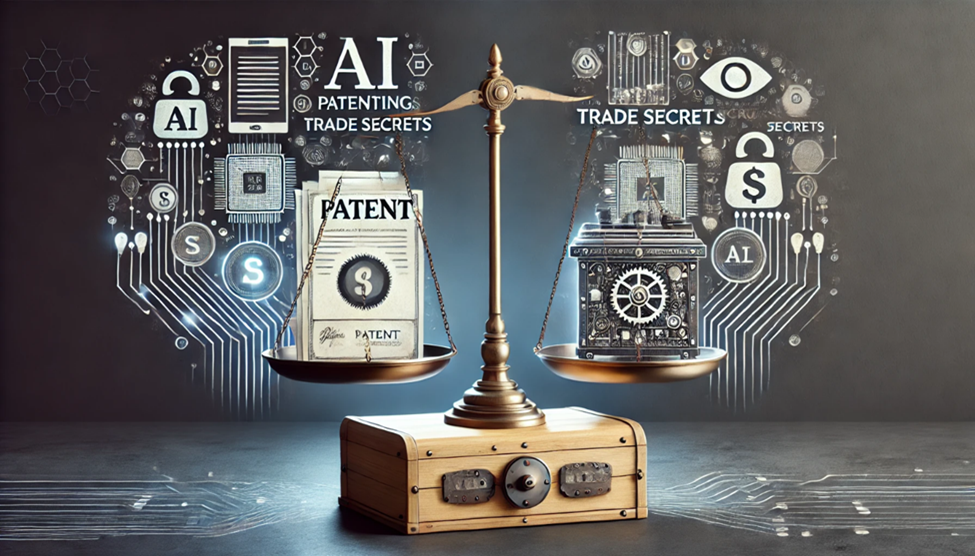
PatentNext Takeaway: When deciding whether to patent AI-based inventions or maintain them as trade secrets, key considerations include the extent of public disclosure and the detectability of the AI model. Deploying an AI model in consumer-facing devices or making its output public often supports patenting to secure exclusivity. On the other hand, low detectability and sensitive training data, such as personal or medical information, may favor trade secret protection. Balancing these factors alongside the need for sufficient disclosure to meet patent requirements allows businesses to safeguard their innovations while mitigating risks.Continue Reading AI-based Inventions: Patenting vs. Trade Secret Considerations

PatentNext Takeaway: This post highlights the FDA’s increasing regulatory efforts for artificial intelligence (AI) and machine learning (ML)-enabled medical devices (MLMDs), with a focus on managing device AI/ML updates through Predetermined Change Control Plans (PCCPs). The FDA emphasizes five guiding principles for PCCPs to ensure safety, risk management, and transparency for MLMDs throughout their lifecycle.

PatentNext Takeaway:  WIPO published a Patent Landscape Report on GenAI.  The Patent Landscape Report discusses trends in GenAI, including trends in: GenAI scientific publications, GenAI patents, GenAI models, types of data used in GenAI, and GenAI application areas.Continue Reading WIPO Issues a Patent Landscape Report on Generative AI

PatentNext Takeaway: The USPTO announced its 2024 Guidance Update on Patent Subject Matter Eligibility, particularly focusing on Artificial Intelligence (AI). Effective July 17, 2024, this guidance aims to address examination procedures for U.S. patent applications under 35 U.S.C. § 101, following President Biden’s executive order on the safe development and use of AI. The 2024 AI Guidance is designed to help USPTO personnel apply existing subject matter eligibility rules to AI-related inventions during patent examination, appeal, and post-grant proceedings. It includes case examples from the Federal Circuit, which, although not AI-specific, are relevant for understanding software-related arts. Additionally, it introduces hypothetical examples (new example claims 47-49) illustrating how AI-related patent claims will be analyzed for eligibility. These examples suggest that examiners will scrutinize AI-related claims more rigorously, emphasizing the need for detailed descriptions of how AI features improve technology or technical fields and/or provide a specific medical treatment. While the guidance does not constitute new law, it replaces previous guidance and is expected to be integrated into the MPEP eventually.Continue Reading The USPTO Issues Guidance on Patenting Artificial Intelligence (AI)-related Inventions per 35 U.S.C. § 101 (Subject Matter Eligibility)

PatentNext Takeaway: Can text generated by artificial intelligence (AI) (e.g., an “AI-generated text”) constitute “prior art” pursuant to U.S. patent law? The answer to that question will impact whether AI-generated text can be used to preclude human inventions from issuing as patents in the United States. Third-party entities currently publish AI-generated text for the express purpose of preventing patent inventions from issuing. But this seems to run afoul of U.S. law requiring human “conception,” not to mention the U.S. Constitution, which seeks “[t]o promote the Progress of Science and useful Arts ….” Accordingly, it is possible that Congress or the courts will look not only the to related statutory text, but also to existing court decisions to preclude AI-generated text from constituting “prior art.”Continue Reading Can Artificial Intelligence (AI) Generate Prior Art (e.g., a “Printed Publication”) pursuant to U.S. Patent Law?

PatentNext Takeaway:  The U.S. Patent and Trademark Office (USPTO) recently issued examination guidance regarding patentability for artificial intelligence (AI)-assisted inventions. The guidance states that AI-assisted inventions are not “category unpatentable.” Instead, when a natural person provides a “significant contribution” to an invention, such an invention can be patentable even if an AI system contributed to the invention. While the guidance does not constitute law, it is grounded in law, i.e., the Federal Circuit’s so-called Pannu factors, which serve as a test for ensuring that a natural person contributed, at least in part, to the conception of the invention as required in the Federal Circuit’s Thaler decision on AI inventorship. The guidance also provides several useful guidelines and examples to help patent practitioners determine what constitutes a “significant contribution” for purposes of establishing natural person inventorship and, thus, patentability for AI-assisted inventions.  Continue Reading The U.S. Patent Office provides Inventorship Guidance for AI-Assisted Inventions

PatentNext Takeaway

Demonstrating that a claimed invention provides an “improvement” to an underlying computing device is one of the best ways to achieve patent eligibility pursuant to Section 101 of U.S. Patent Law. However, the Federal Circuit has repeatedly held that an improvement to a “User Experience” (UX) alone is insufficient. The Federal Circuit recently issued yet another case, further cementing its position that improving a UX, without more, fails to demonstrate a technical improvement for satisfying Section 101 per the Alice two-part test.

****Continue Reading Improving a User Experience (UX) Alone Does Not Demonstrate a Technical Improvement for Demonstrating Patent Eligibility Satisfying Section 101